WordPress SEO for SaaS Companies: What's Different and What to Fix First

WordPress SEO for SaaS companies has a specific shape. The marketing site is on WordPress. The product runs somewhere else (a custom React app, a separate subdomain, a different stack entirely). What ranks for the company is the marketing site, and what most SaaS founders do not realise is that generic WordPress SEO advice was written for content publishers, not SaaS marketing sites.
The keyword targets are different. The conversion path is different. The page templates that move revenue are different. Here is what changes when WordPress SEO meets SaaS, and what to fix first.
Why this combination is so common
WordPress runs roughly 43% of all websites, per W3Techs CMS market share data. A meaningful slice of that is B2B SaaS marketing sites at the $300K to $5M ARR range. Founders pick it because:
- Content workflows are familiar (the marketing lead has used WordPress before)
- The plugin ecosystem covers most needs without engineering time
- A custom marketing site is hard to justify when product is the priority
- WordPress separates from the product app cleanly
This is the right call. The problem is that the SEO strategy applied to that WordPress site usually was not built for SaaS.

Where generic WordPress SEO advice goes wrong for SaaS
Most WordPress SEO content is written for publishers, agencies, and ecommerce stores. The advice assumes:
- Traffic is the goal (impressions, sessions, ad revenue)
- The blog is the primary content asset
- Conversion is a download or subscription
For SaaS, none of those map cleanly. The goal is not traffic. The goal is qualified trials and demos from buyers searching commercial-intent queries. A SaaS site getting 50,000 monthly visitors that convert at 0.2% is losing to a site getting 5,000 visitors that convert at 4%.
The specific mismatches we see most often:
Over-investment in blog content, under-investment in commercial pages. A typical SaaS WordPress site has 80 blog posts and three thin pricing or comparison pages. The blog brings top-of-funnel traffic that rarely converts. The commercial pages, the ones that close deals, are missing.
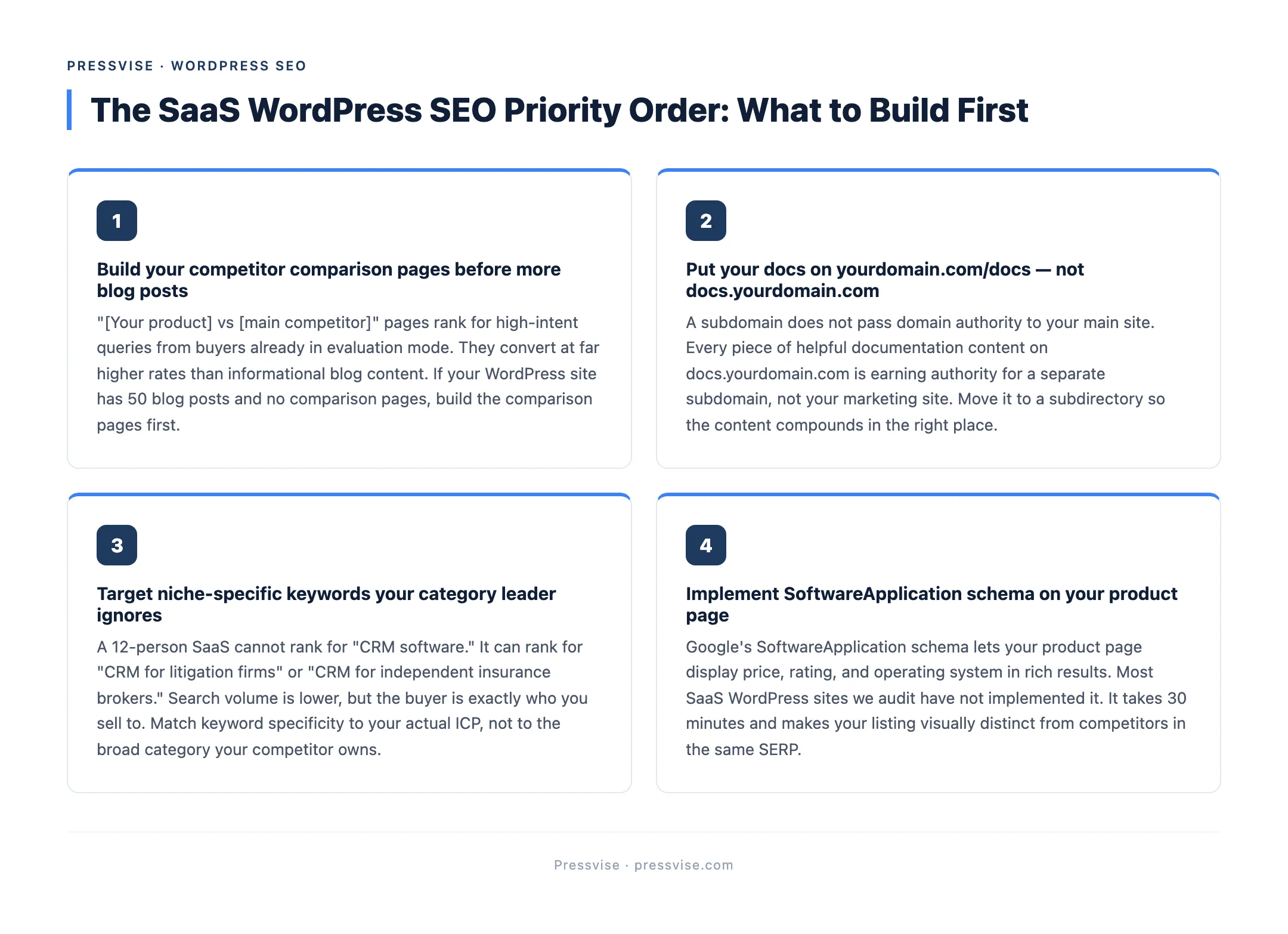
Targeting category keywords that are out of reach. A 12-person SaaS company at $700K ARR cannot rank for “CRM software” against Salesforce and HubSpot. They can rank for “CRM for litigation firms under 20 lawyers” if that is what they actually sell. Generic SEO advice tells you to chase volume. SaaS SEO tells you to chase fit.
Ignoring the product-led keyword cluster. Every SaaS has a cluster of queries buyers search at the decision stage: “[product] vs [competitor]”, “[product] alternatives”, “[product] pricing”, “[product] integrations”, “[product] for [use case]”. Most SaaS WordPress sites have zero or one of these pages. They should have 20 to 40.
The pages that move SaaS revenue (in order)
If we audit a SaaS WordPress site and have to pick where to invest first, the order is roughly:
1. Comparison and alternatives pages. “[Your product] vs [main competitor]” and “Alternatives to [main competitor]”. These rank for high-intent queries from buyers already in evaluation. They are the highest-converting pages on most SaaS sites we work with.
2. Use case and vertical pages. “[Your product] for [vertical]” or “[Your product] for [use case]”. One per meaningful customer segment. These let you rank for narrower queries with much less competition.
3. Integration pages. One page per major integration ([Your product] + Slack, + Salesforce, + HubSpot). Even if the integration is light, the page captures buyers searching for “[their tool] + your category”.
4. Pricing page (with a real pricing table, not a “contact us”). Pricing pages rank for branded queries and convert traffic that arrived through the blog.
5. The blog, last. Blog content compounds slowly and converts at low rates. It belongs in the strategy, but not as the first investment when commercial pages are missing.
The technical layer for SaaS WordPress sites
The technical audit checklist still applies. We covered the full version in the WordPress SEO audit checklist. For SaaS specifically, three items get extra attention:
Subdomain vs subdirectory architecture. If the product app is on app.yourdomain.com and the marketing site on yourdomain.com, the SEO strategy needs to consolidate authority on the right host. Documentation and changelogs especially. Putting docs on docs.yourdomain.com instead of yourdomain.com/docs leaks authority.
JavaScript rendering on commercial pages. Page builders (Elementor, Bricks, Divi) often output heavy client-side rendering that hurts crawlability for SaaS comparison pages. Test rendered HTML, not source view.
Schema for software products. Google’s SoftwareApplication schema lets product pages get rich result eligibility (price, rating, OS). Most SaaS sites we audit have not implemented it.
Founder-level mistakes
Two patterns we see repeatedly in SaaS founder-led marketing teams:
Treating SEO as a content output. “We publish two blog posts a week” is not SEO. SEO is the technical foundation, the keyword strategy, the link profile, and the content. Content is one quarter of it.
Switching strategies every six months. SEO is the slowest-moving channel in a SaaS marketing mix. A founder who sees flat traffic at month 4 and pivots to paid is leaving the compounding to the next agency. The minimum runway for a SaaS WordPress SEO programme is 9 months. Less than that, do not start.
When to bring in a specialist
If your SaaS WordPress site is older than 12 months, has more than 30 indexed pages, and rankings have not moved in the last 6 months despite content investment, the problem is structural. That is what WordPress SEO specialists like Pressvise audit and fix, often starting with our WordPress SEO consulting engagement. For ecommerce SaaS or product companies running WooCommerce alongside the marketing site, the second layer covered in WooCommerce SEO experts: what to look for before you hire applies on top.
The order is the audit first, then commercial pages, then the technical fixes that are blocking the audit findings, then content. The blog comes last because it is the slowest layer to move and the easiest to over-invest in early.
For a deeper view of why specialist depth matters versus generalist breadth, see WordPress SEO specialists vs generalists.