WordPress SEO Experts: What Separates the Specialists from the Generalists

WordPress SEO experts who specialize in the platform solve problems that generalist agencies cannot diagnose. The difference is not effort or intent. It is whether the person working on your site understands the technical layer between WordPress and Google.
That distinction decides whether month one produces a report or produces results.
What “WordPress SEO expert” actually means
A WordPress SEO expert is not someone who knows SEO and happens to use WordPress. It is someone who understands how the WordPress technical stack directly shapes search performance.
That stack includes themes that control Core Web Vitals (the three metrics Google uses to measure page speed, visual stability, and interactivity). It includes plugins that can create crawl conflicts — situations where two or more plugins interfere with each other, breaking sitemaps, duplicating meta tags, or blocking search engine bots. It includes URL and category architecture that either concentrates or fragments your domain authority (a measure of your site’s overall credibility in Google’s system).
Platform-specific SEO matters because WordPress powers 43% of all websites. That scale means the problems are well-documented, but they are also specific. A redirect loop caused by a caching plugin behaves differently than a redirect loop on a custom-built site. A DOM with 1,500+ nodes because Elementor nests five wrapper divs per section is a WordPress problem, not a generic speed problem. The fix lives in the theme layer, not in a PageSpeed Insights suggestion.

What a generalist SEO agency does on WordPress
A generalist SEO agency follows a platform-agnostic playbook. They run a crawl in Screaming Frog. They pull keyword data from Ahrefs or Semrush. They produce a content calendar. They install Yoast and configure the basics — XML sitemap, meta templates, breadcrumbs.
The deliverables look professional. They are professional. And for the content layer of SEO, this work has value.
But generalists treat WordPress as a content management system, not as a technical environment. They write blog posts without auditing the theme. They recommend “improve page speed” without identifying what in the theme is slow. They install Yoast and assume the technical SEO is handled — when in reality, Yoast green lights check formatting, not ranking factors.
The pattern is consistent. We inherit sites from generalist agencies where the content is solid, the keyword research is reasonable, and the technical foundation has never been touched. The theme still loads 400KB of unused CSS. The plugin stack has three overlapping caching layers. The category structure spreads authority across 30 thin archive pages that compete with each other.
None of that shows up in a standard audit report.
What a WordPress SEO specialist does differently
A WordPress SEO specialist starts at the theme layer, not the keyword layer.
That means auditing Core Web Vitals at the source — not just running PageSpeed Insights, but inspecting what the theme actually ships to the browser. Divi loads its entire framework CSS on every page regardless of which modules are used. Avada injects render-blocking JavaScript for animations that may not even appear above the fold. Elementor creates deeply nested DOM structures that slow down Interaction to Next Paint (INP, the metric measuring how fast a page responds to clicks). These are not generic speed problems. They are WordPress theme problems with WordPress-specific fixes.
A specialist also reviews the full plugin stack for conflicts. WordPress sites average 20-30 active plugins. When a security plugin blocks Googlebot, when two SEO plugins fight over canonical tags, when a caching plugin serves a stale sitemap that omits your newest pages — those are crawl conflicts that require knowing how WordPress plugins interact with each other and with search engine bots.
Then there is URL and category architecture. WordPress generates URLs from categories, tags, date archives, author pages, and pagination. A specialist restructures this to build content clusters (groups of related pages that reinforce each other’s authority on a topic) instead of letting WordPress default settings fragment your site into hundreds of thin, competing URLs.
Finally, a specialist understands schema markup (structured data that helps Google display rich results) in the WordPress context. They know which plugins generate valid schema, which ones create conflicts, and when to implement custom JSON-LD instead of relying on plugin output.
The measurable difference
A generalist audit flags “improve page speed.” A specialist audit identifies that your theme loads 412KB of unused CSS, 180KB of render-blocking JavaScript for animations you disabled two years ago, and serves unoptimized hero images through a plugin that bypasses your CDN. Then they fix it at the source.
The difference shows up in numbers.
Core Web Vitals move from failing to passing — not because someone compressed images, but because the theme stopped shipping code that was never needed. Crawl efficiency improves because conflicting plugins are resolved and Googlebot can access every page cleanly. Internal linking shifts from random sidebar widgets to intentional clusters built around your WordPress SEO strategy.
Within 6-10 weeks of technical fixes, keyword movement follows. Not because the content changed, but because Google can now crawl, render, and evaluate the content that was already there.
What we see when we inherit a site from a generalist agency is that the content was never the problem. The content was fine. The platform was the problem, and nobody looked at it.
How to tell which one you are working with
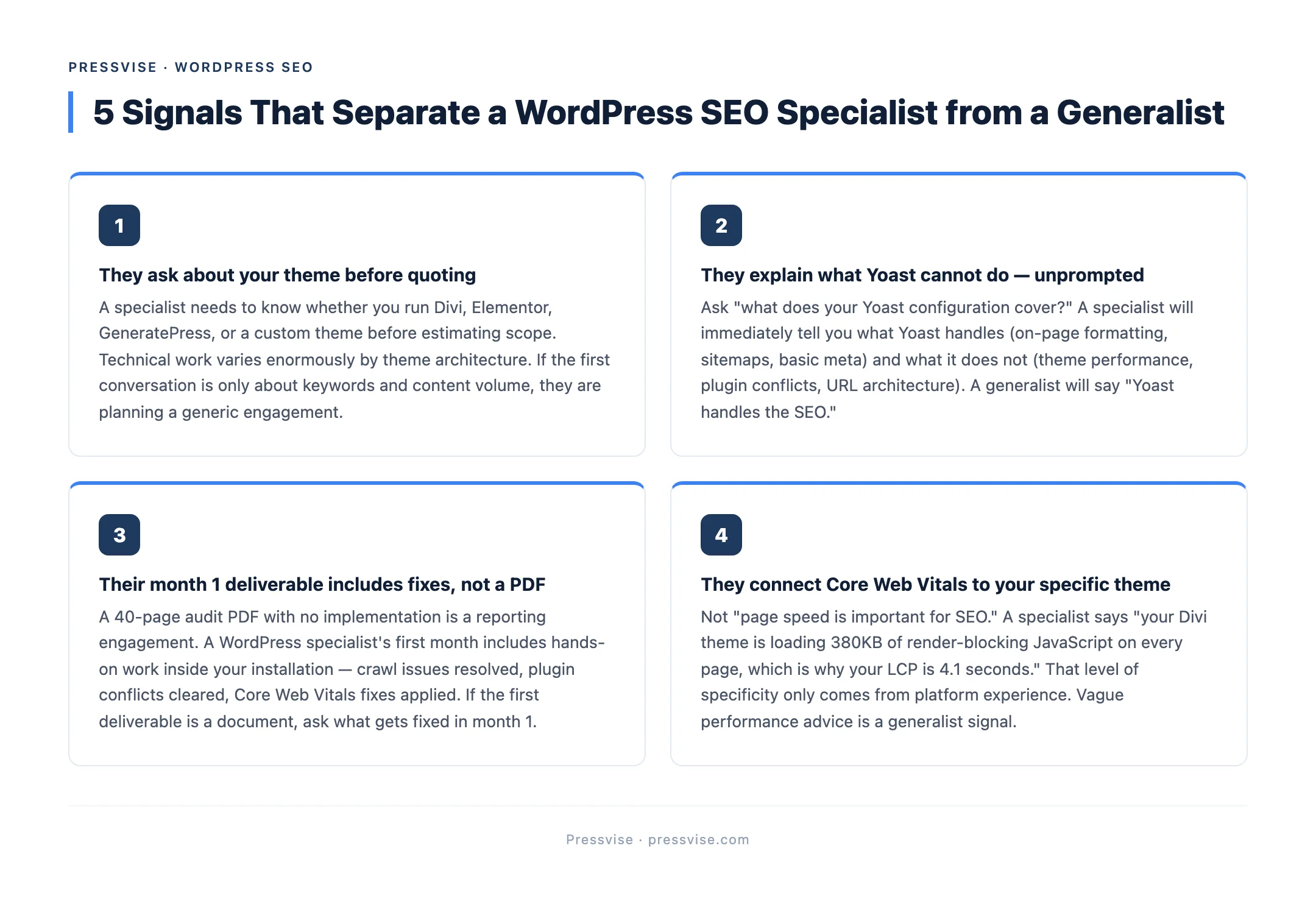
Five signals separate a WordPress SEO specialist from a generalist who happens to work on WordPress sites.
They ask about your theme and plugin stack before quoting you. A specialist needs to know whether you are running Divi, Elementor, GeneratePress, or a custom theme before they can estimate the scope of technical work. If the first conversation is only about keywords and content volume, they are planning a generic engagement.
Their own website ranks for WordPress-specific keywords. Check whether they appear in search results for terms related to WordPress SEO specifically — not just “SEO agency” or “digital marketing.” If their expertise is platform-specific, their content should reflect that.
They can explain what Yoast can and cannot do. Ask them. A specialist will tell you that Yoast handles on-page formatting, XML sitemaps, and basic meta management — but it cannot audit your theme, resolve plugin conflicts, or restructure your site architecture. A generalist will tell you Yoast “handles the SEO.”
Their month one includes technical fixes, not just a document. If the first deliverable is a 40-page audit PDF with no implementation, that is a reporting engagement. A specialist’s first month includes hands-on technical SEO work — fixing what the audit found, not just describing it.
They mention Core Web Vitals in the context of your theme. Not “page speed” as an abstract concept. They connect performance metrics to the specific theme and plugin stack running on your site. That specificity only comes from platform expertise.
FAQ
Do I need a WordPress-specific SEO expert, or will any SEO agency work?
If your WordPress site has content but no ranking movement, the gap is almost certainly platform-specific. A generalist handles keyword research and content strategy. But theme performance, plugin conflicts, and URL architecture require someone who works inside WordPress daily. A specialist diagnoses the platform-level problems, not just the symptoms.
What can a WordPress SEO specialist fix that a generalist can’t?
Theme-layer optimization and plugin-stack diagnosis are the core differences. A specialist identifies that your Divi theme ships 400KB of unused CSS and fixes it at the source. They resolve conflicts between caching, SEO, and security plugins that create crawl issues invisible to standard audit tools. They restructure WordPress’s default category architecture into a content cluster model that concentrates authority.
How do I know if my SEO provider understands WordPress?
Ask three questions: what is the most common Core Web Vitals problem in WordPress themes, how do you audit plugin conflicts, and what does Yoast not handle? A specialist answers with specifics — naming themes, describing plugin interactions, and explaining tool boundaries. Vague answers about “best practices” signal a generalist.
If your WordPress site has solid content but flat rankings, the problem is likely in the platform layer, not the content. WordPress SEO specialists like Pressvise start where generalist agencies stop — inside the theme, the plugin stack, and the architecture that determines whether Google can actually see what you have built.