WordPress SEO Agency vs Freelancer: What the $500/Month Difference Actually Buys You

Choosing between a WordPress SEO agency and a freelancer comes down to what your site actually needs fixed. The price gap is smaller than most people assume — and the gap in WordPress-specific capabilities is larger.
Here is what each option delivers, what it costs, and where each model breaks down on a WordPress site specifically.
The Real Cost Comparison
The difference between a WordPress SEO freelancer and an agency is typically $250 to $500 per month — not the $2,000 gap most business owners expect.
A freelancer working on WordPress SEO charges between $50 and $100 per hour, or $500 to $1,500 per month on a retainer (a fixed monthly fee for ongoing work). According to Upwork’s rate data for WordPress SEO specialists, the median sits around $75/hour, with retainers clustering at $800 to $1,200/month for experienced freelancers.
An agency retainer — meaning a monthly agreement where the agency handles your SEO as an ongoing service — runs $750 to $3,000 per month. Clutch’s 2025 agency pricing survey puts the median SEO agency retainer at $1,500/month for small to midsize businesses.
For a WordPress business at $500K to $2M in revenue, the realistic comparison is a $1,000/month freelancer versus a $1,500/month agency. That $500/month delta buys you something specific — and whether it is worth it depends entirely on what is broken on your site.

What a WordPress SEO Freelancer Typically Delivers
A good WordPress SEO freelancer handles keyword research, blog content, and basic on-page optimization. They update your meta titles, write posts targeting specific search terms, and configure your SEO plugin (Yoast, RankMath, or similar).
This is real, useful work. If your WordPress site is technically sound and you need someone to execute a content strategy you have already defined, a freelancer can do that well.
What most freelancers cannot do — and this is the WordPress-specific part — is fix problems that live deeper in your stack:
- Core Web Vitals in the theme layer. Core Web Vitals (CWV) are the speed and responsiveness scores Google uses to rank your site. On WordPress, CWV failures often originate in the theme code itself, not in the content or plugins. Fixing this requires editing PHP template files, optimizing render-blocking resources, and sometimes replacing theme components entirely. Most SEO freelancers do not touch theme code.
- Plugin conflict resolution. WordPress sites accumulate plugins over time. Two plugins loading the same JavaScript library, or a caching plugin conflicting with a form plugin, can silently break page speed or crawlability. Diagnosing this requires deactivating plugins systematically and testing — work that sits outside a typical SEO freelancer’s scope.
- URL architecture restructuring. WordPress generates URLs based on permalink settings, category structures, and page hierarchies. A site with years of accumulated posts, changed permalink formats, and orphaned category pages often has authority fragmented across dozens of thin URLs. Consolidating this is architectural work, not content work.
None of these are criticisms of freelancers. They are structural limitations of the freelancer model when applied to a CMS as technically layered as WordPress.
What a WordPress SEO Agency Delivers
An agency that specializes in WordPress SEO fixes the technical foundation first, then builds content on top of it. The sequence matters.
In our experience, most WordPress sites that come to us after a freelancer engagement have the same pattern: 20 to 40 blog posts published, reasonable keyword targeting, and rankings that have not moved. The content is fine. The foundation underneath it is broken.
A WordPress SEO agency’s first month typically looks like a full technical audit — a systematic review of your site’s crawlability, speed, URL structure, plugin health, and on-page setup. The difference from a freelancer’s audit is that an agency audit produces fixes, not a PDF of recommendations. Theme-layer CWV issues get patched. Redirect chains get cleaned up. Plugin conflicts get resolved. The site that enters month 2 is structurally different from the site that entered month 1.
From month 2 onward, content and monitoring layer on top of a site that can actually rank. Blog posts target low-competition keywords that move in weeks, not months. Internal linking connects those posts to service pages. Monthly reporting tracks what is working and what needs adjustment.
The short version: freelancers typically start writing content. Agencies start by making the site capable of ranking, then write content. On WordPress, that order makes a measurable difference.
The WordPress-Specific Risks of Each Model
Every hiring decision carries risk. The risks look different for WordPress SEO specifically.
Freelancer risks on WordPress:
The most common problem we see is the disappearing freelancer. A freelancer works on your site for three to four months, installs several plugins, changes your permalink structure, adjusts your caching setup — then the engagement ends. No documentation. No record of what was changed or why. Your site now has a configuration that only one person understood, and that person is gone.
On a static HTML site, this is annoying. On WordPress, it is genuinely dangerous. Plugin settings interact with each other. A caching configuration that worked with the old theme breaks after a theme update. The URL changes the freelancer made created redirect chains that silently erode your crawl budget. Unwinding this takes longer than the original work.
The other freelancer risk is single-point-of-failure expertise. One person rarely covers content strategy, technical WordPress development, and SEO analysis at a high level simultaneously. The freelancer who writes well may not diagnose a render-blocking theme issue. The one who understands Core Web Vitals may not write content that ranks.
Agency risks on WordPress:
Agencies cost more — that is the obvious one. A $750 to $1,500/month retainer is a real line item for a business under $2M in revenue.
The less obvious risk is depersonalization. Larger agencies rotate account managers. Your point of contact changes quarterly. The person who audited your WordPress stack in month 1 is not the person managing your account in month 6.
For WordPress work specifically, continuity matters. Your site’s plugin configuration, theme quirks, and content architecture are context that takes time to learn. An agency that maintains consistent account ownership — or documents thoroughly enough that transitions are seamless — mitigates this risk.
Decision Framework: Which to Choose
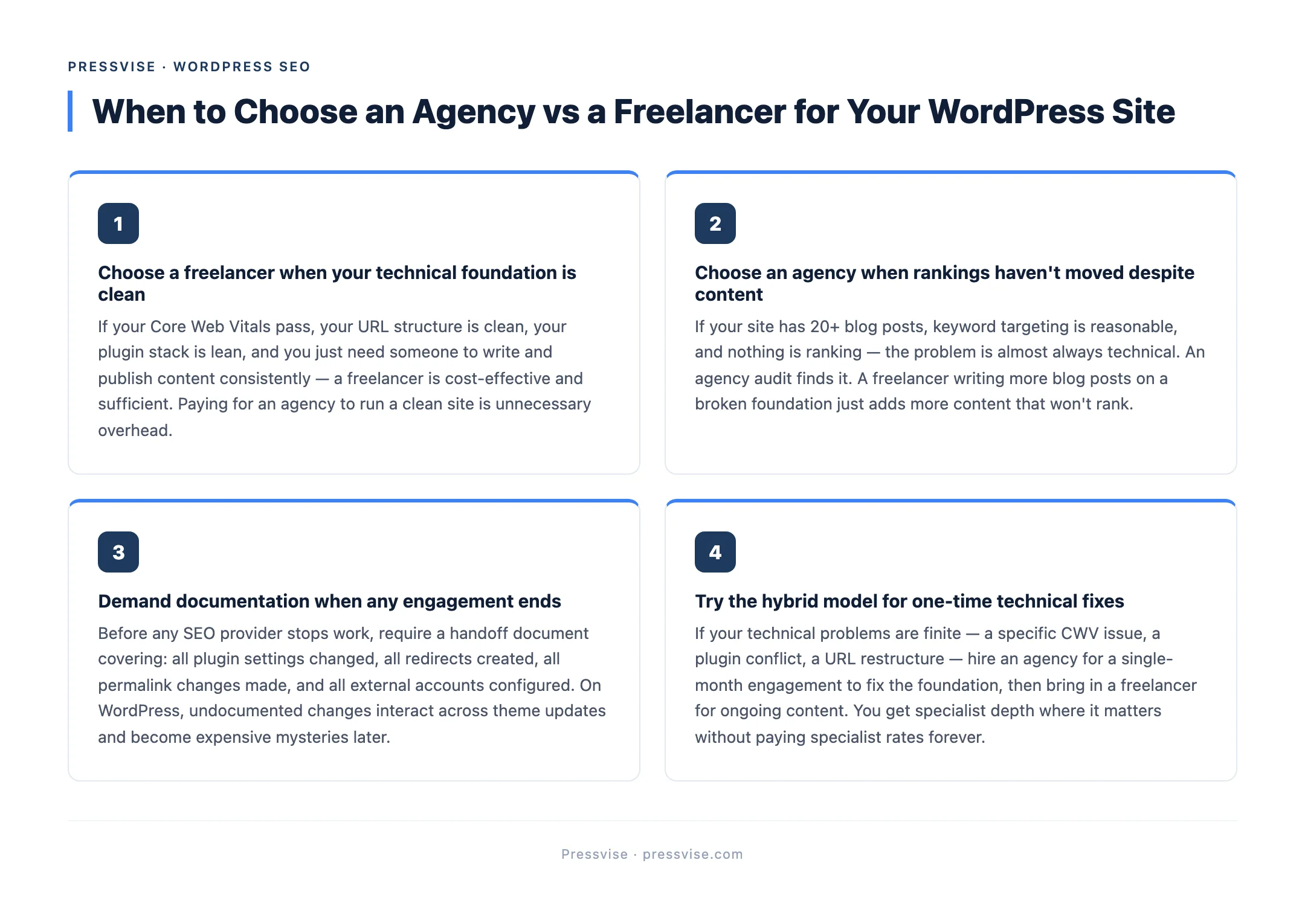
Choose a freelancer if your WordPress site is technically healthy, your Core Web Vitals pass, your URL structure is clean, and you primarily need someone to execute content. You should be able to define the keyword strategy and review the work. A freelancer in this scenario is cost-effective and sufficient.
Choose an agency if your WordPress site has technical debt — slow load times, plugin bloat, a URL structure that has changed multiple times, or rankings that have not moved despite consistent content. Also choose an agency if you have already been through a freelancer engagement that ended without documentation or results. The pattern of hiring a WordPress SEO expert after a failed freelancer stint is common enough that agencies build their onboarding around it.
A middle path exists for sites that need a one-time technical fix but ongoing content support: hire an agency for a single-month WordPress SEO consulting engagement to audit and fix the foundation, then bring in a freelancer for monthly content. This hybrid approach works when the technical problems are fixable in a defined scope and the content needs are straightforward.
If your WordPress site has been stuck despite content investment, the issue is almost certainly technical. That is where a dedicated WordPress SEO agency earns the price difference — not by writing more content, but by fixing what sits underneath it.
To understand what that technical foundation looks like in practice, this WordPress SEO guide breaks down the three platform-specific problems most agencies miss. And if budget is the primary concern, here is what affordable WordPress SEO should actually cost at different service levels.
FAQ
Is a WordPress SEO freelancer cheaper than an agency?
Usually, but the gap is smaller than expected — typically $250-$500/month, not thousands. A qualified freelancer charges $800-$1,200/month. A WordPress-specialized agency starts at $750-$1,500/month. The value gap depends on whether your site needs technical fixes (agency advantage) or just content (freelancer-sufficient).
What happens if my WordPress SEO freelancer disappears?
You inherit a site configuration only one person understood. Plugin settings, caching rules, and redirect maps are undocumented. On WordPress, these interact — a theme update can break a caching setup, and without documentation, diagnosing the issue means starting from scratch.
Can a general SEO freelancer handle WordPress-specific issues?
A general SEO freelancer handles keyword research, content writing, and basic on-page optimization on any CMS. What they typically cannot fix are the platform-specific blockers: Core Web Vitals failures in theme code, plugin conflicts affecting crawlability, and URL architecture issues from WordPress’s category system. These require WordPress development knowledge on top of SEO expertise.