WordPress SEO Agency vs Yoast / Rank Math: What a Plugin Can't Do

Yoast and Rank Math are excellent. They are also not what most struggling WordPress sites need next. If rankings are flat and you are about to install a third SEO plugin, the layer that needs work is almost certainly somewhere else.
We audit WordPress sites for a living. Almost every flat-ranking site we open already has Yoast or Rank Math installed, set up correctly, and showing green lights across the board. The plugin is doing its job. The problem is sitting in a different part of the stack — and that is the honest split between a plugin and a WordPress SEO agency.

What Yoast and Rank Math do well
Both plugins format the on-page signals Google reads when it crawls a page. That is a real job, and they do it cleanly.
Yoast is the older, more conservative option. Its codebase is mature, releases are slower, and the schema graph it outputs is opinionated and hard to break. The traffic-light editor (red, orange, green dots in the sidebar) is either useful guidance or a constant interruption depending on your team. Editorial teams that have used Yoast for years generally stick with it for a reason: it ships fewer surprises.
Rank Math packs more into the free tier — redirect manager, 404 monitor, multi-keyword tracking, a more configurable schema generator. The UI is quieter and surfaces analysis on demand instead of nagging. On large sites it uses custom database tables, which queries faster but is harder to migrate off.
Here is the side-by-side most comparison posts bury behind affiliate links:
| Feature | Yoast Free | Rank Math Free |
|---|---|---|
| Title, description, OG tags | Yes | Yes |
| XML sitemap | Yes | Yes |
| Basic schema (Article, Org, Breadcrumb) | Yes | Yes |
| Redirect manager | Premium ($99/yr) | Free |
| 404 monitor | Premium | Free |
| Multi-keyword tracking per post | Premium | Free (up to 5) |
| Internal linking suggestions | Premium | Premium |
| Schema customisation | Limited | High |
| Database footprint | Post meta | Custom tables |
| Breaking releases (last 3 years) | Rare | Occasional |
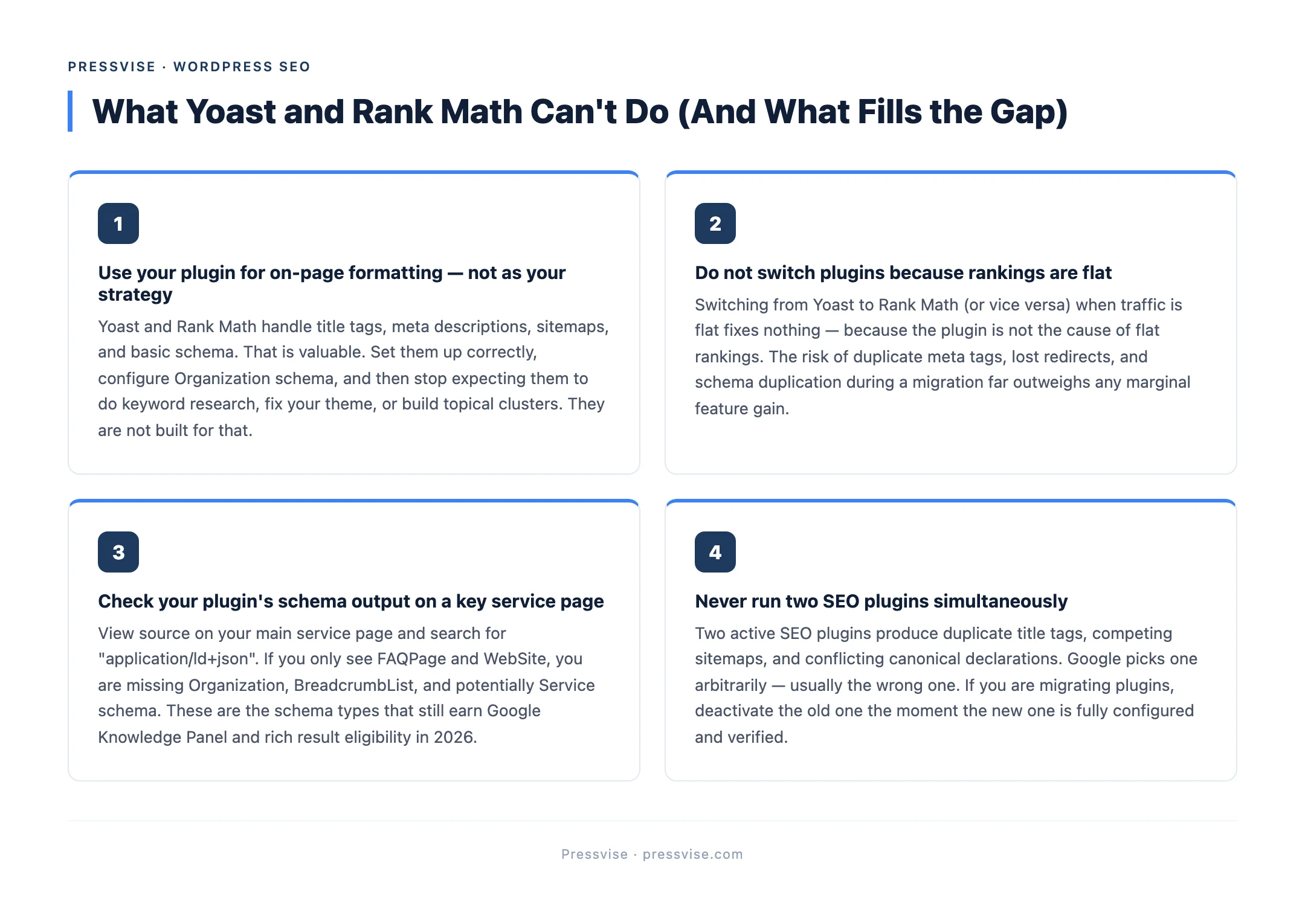
The honest answer is: pick the one your team will open weekly. Stay with what you have if rankings are flat — switching plugins for the sake of switching adds risk without an upside.
We wrote up the full plugin-to-plugin breakdown in our Yoast vs Rank Math comparison if you need that decision made first.
What neither plugin can do
This is the part that decides whether your WordPress site ranks, and it sits entirely outside Yoast and Rank Math.
Keyword strategy and selection. The plugin checks whether a focus keyword appears in the H1, the URL, and the first paragraph. It does not decide whether that keyword is worth targeting, whether the search intent matches what you sell, or whether the keyword difficulty (KD — a 0-100 score of how hard it is to rank) is low enough to be reachable. Picking the wrong keyword is the most common reason WordPress sites stay flat.
Content writing. Plugins format. They do not produce the actual article. The reason most green-lit Yoast pages do not rank is that the page itself does not deserve to — thin, undifferentiated, or written for the wrong reader.
Technical fixes in the theme layer. Core Web Vitals (LCP, INP, CLS — Google’s three page-experience metrics) live in your theme code, your image strategy, and your plugin stack. No SEO plugin touches them. We wrote about why WordPress Core Web Vitals problems live in the theme layer because almost every flat-ranking site we audit has at least one CWV issue the plugin cannot see.
Schema beyond the defaults. Yoast and Rank Math both ship Article, Organization, and Breadcrumb schema out of the box. They do not ship Product schema with the right inventory and price logic for WooCommerce, FAQ schema validated against the specific question patterns Google rewards, How-To schema for tutorial content, or LocalBusiness schema with the right geo fields. Custom schema is a developer job, not a plugin job.
Content cluster architecture. A topical cluster is a pillar article plus a set of supporting posts that interlink correctly. The plugin suggests adding a link. It does not architect the cluster.
Crawl budget management. Auto-generated tag pages, author archives, parameter URLs, and old WooCommerce variation URLs can eat crawl budget on any site over a few hundred pages. The plugin does not see this.
Link equity and backlink acquisition. Off-page authority sits entirely outside any plugin’s reach.
E-commerce category page optimization. WooCommerce category pages need filter logic, faceted navigation handling, and pagination tags that respect crawl rules. None of this is a Yoast or Rank Math setting.
Migrations. Replatforming, URL structure changes, theme switches — all of it requires a redirect map and a regression plan that no plugin generates for you.
If you are choosing between Yoast and Rank Math because rankings are flat, you are optimising the wrong layer. We covered the audit angle in detail in the audit checklist that actually matters.
The decision tree
Three honest scenarios.
A plugin is genuinely all you need. Your WordPress site has under 50 pages. The owner or in-house marketer is the one writing content. Organic traffic is a nice-to-have, not the engine of revenue. You can give an hour a week to checking the plugin’s recommendations and shipping fixes. Stay with Yoast or Rank Math. Save the agency money for something else.
You need an agency. Revenue depends on organic traffic. The site sits over 200 pages or runs an e-commerce catalogue. A technical migration is looming (replatform, theme rebuild, URL restructure). Competitors are pulling away in the SERP. Core Web Vitals are failing and the in-house dev team is not SEO-fluent. In any of these scenarios, a plugin alone leaves measurable revenue on the table.
You need both — and this is most $1M+ WordPress sites. The plugin handles on-page formatting across a few hundred pages without manual work. The agency owns the technical layer, content strategy, and the questions the plugin cannot answer. Treating them as alternatives is the mistake we see most often when we open a new client’s site.
Where Pressvise fits
We are a WordPress SEO agency that works with, not against, the plugin you already have. Yoast, Rank Math, SEOPress — we leave whichever one your team already trusts and configure it properly. We do not replace plugins as a service line.
What we do own is everything outside it: the WordPress technical SEO layer, content strategy, the migration plan when something needs to move, schema beyond the defaults, and the audit that surfaces what the plugin can’t see.
Scope is honest. If your site is under 50 pages and the owner has time to write, we will tell you to keep using your plugin and not hire us. If revenue depends on organic and the plugin’s green lights are not translating into rankings, that is the conversation we are built for.
If your WordPress site has Yoast or Rank Math installed correctly and rankings are still flat, the layer that needs work is somewhere we can help with.